
Dear Reader,
Being nice and being empathetic are not the same thing.
Niceness is usually about making an interaction pleasant. It can mean offering encouragement, avoiding conflict, or telling someone what we think will make them feel better.
Empathy requires something much deeper. It requires us to understand another person well enough to recognize what they actually need, even when that response may be difficult, uncomfortable, or contrary to what everyone else is demanding.
Empathy has three dimensions.
Experiential empathy comes from having lived through something similar. Emotional empathy allows us to feel what another person is feeling. Intellectual empathy helps us understand why they feel that way and what we need to do about it.
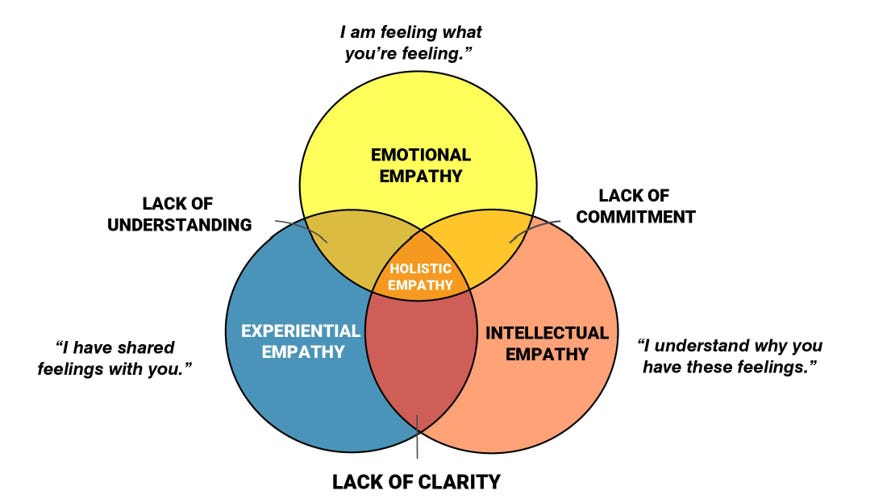
When all three are present, empathy becomes an extraordinarily practical leadership capability.
Recently, my team had been running hard while supporting a major organizational transformation. They had invested enormous amounts of energy into the work, but as the final stretch approached, they were spent.
I knew how they were feeling. They were tired, exhausted, and even scared that despite everything they had done, the transformation might still fall short. I had been in that position before, so I understood the experience. I could feel the weight they were carrying, and I could see why they were putting so much pressure on themselves.
I could also see something they were struggling to recognize.
Working themselves into the ground during the final month was not going to determine whether the transformation succeeded. They had already done everything they could to create the conditions for success. The people inside the organization now had to carry it forward.
The client was still applying pressure, but the more dangerous pressure was coming from within. My team felt personally responsible for an outcome that was no longer entirely within their control.
It came down to one conversation.
I gave them permission to go to the minimum in whatever way made sense for each of them.
For one person, that meant taking some time off. For the other, it meant coasting to the daily work for a few weeks. They did not need the same solution because they were not experiencing the pressure in the same way.
This was not about giving up or abandoning the work. It was recognizing that the value of another heroic effort had reached its limit. Continuing to push harder would have depleted them without materially improving the outcome.
That decision reminded me of a story I heard much earlier in my career.
I was serving on a board, and our president told us about a consulting client facing a high stakes project. The organization was falling behind, the pressure was mounting, and the executive team decided they needed everyone to work harder.
They cancelled holidays and suspended the Christmas break until further notice.
The executives believed that applying more pressure was the responsible thing to do. The project was in trouble, so everyone needed to sacrifice until it was back on track.
The president’s first intervention was to help those executives understand that the team needed less pressure, not more.
Cancelling the break might have created more working hours, but it would not have created better thinking, stronger judgment, or more effective decisions. The people were already overloaded. Taking away their opportunity to recover would only push them further into distress.
This is where empathy and niceness are often confused.
Empathy does not mean making people comfortable or protecting them from every difficult situation. Sometimes empathy means challenging someone, holding them accountable, or allowing them to struggle long enough to grow.
At other times, empathy means recognizing that challenge has turned into overload and that continuing to push will make performance worse.
The difference is not how kind the response appears. The difference is whether the leader understands what is actually happening for the person in front of them.
Pressure has a productive zone. Eustress can create energy, focus, and urgency. It can stretch our abilities and help us perform at a higher level. But when that pressure becomes excessive distress, the benefits disappear. Cognitive capacity narrows, creativity declines, judgment suffers, and people begin operating from fear rather than clarity.
Many leaders respond to declining performance by increasing the very pressure that is causing it.
Deadlines become tighter. Meetings become more frequent. Updates become more detailed. Evenings, weekends, and holidays begin disappearing.
The leader sees a team slowing down and assumes they need to be pushed. An empathetic leader considers whether they are slowing down because they have already been pushed too far.
Leadership requires constantly tuning that edge. Too little pressure and there may be no movement. Too much pressure and people lose access to the capabilities you need most.
Sometimes the most effective leadership decision is to ask for more.
Sometimes it is to give people permission to do less.
What Have I Been Reading?
This experience reminded me of my own book, The Hidden Project Drivers.
Much of the book is about helping people shed the mental load that prevents them from functioning at their best. It offers practical techniques for managing threat, pressure, and stress, both for ourselves and for the people we lead.
People cannot think clearly when their mental capacity is consumed by fear, imagined consequences, unrealistic expectations, or concerns about disappointing others. The external workload may not have changed, but their internal experience of that workload can leave them unable to move effectively.
Leadership is not about removing every challenge. Growth requires some tension. The goal is to keep that tension inside a productive zone, where people are stretched without becoming overwhelmed.
That requires more than being nice. It requires enough empathy to see the work through someone else’s eyes, feel what the experience is doing to them, and understand what intervention will help them regain clarity and agency.
Where Have My Travels Taken Me?
This week, I am in Vancouver visiting family.
I decided that this time I would actually disconnect. I did not even bring my computer.
I cannot remember the last time I took an entire week off and fully stepped away. It has been so long that I genuinely cannot place it.
I have built a lifestyle where my work and personal life are integrated. I do not believe there is such a thing as work life balance, at least not in the way it is usually described. I have designed my life so that work, family, writing, travel, and personal interests can coexist in a way that is sustainable over long periods.
That means I rarely feel the need to escape from my work. It also means I rarely disconnect from it completely.
Leaving the computer behind will be an interesting experiment. I want to see what happens when I remove the option of quickly checking something, responding to one message, or working through an idea while it is fresh.
Perhaps the lesson will be that the life I have designed already works exactly as intended.
Perhaps it will remind me that even a sustainable pace benefits from occasionally coming to a complete stop.
Closing Insight
Niceness asks, “What can I do to make this person feel better?”
Empathy asks, “What does this person actually need from me right now to improve their situation?”
Sometimes the answer is encouragement. Sometimes it is challenge. Sometimes it is accountability.
And sometimes it is permission to stop pushing so hard.
Until next time,
Kursten